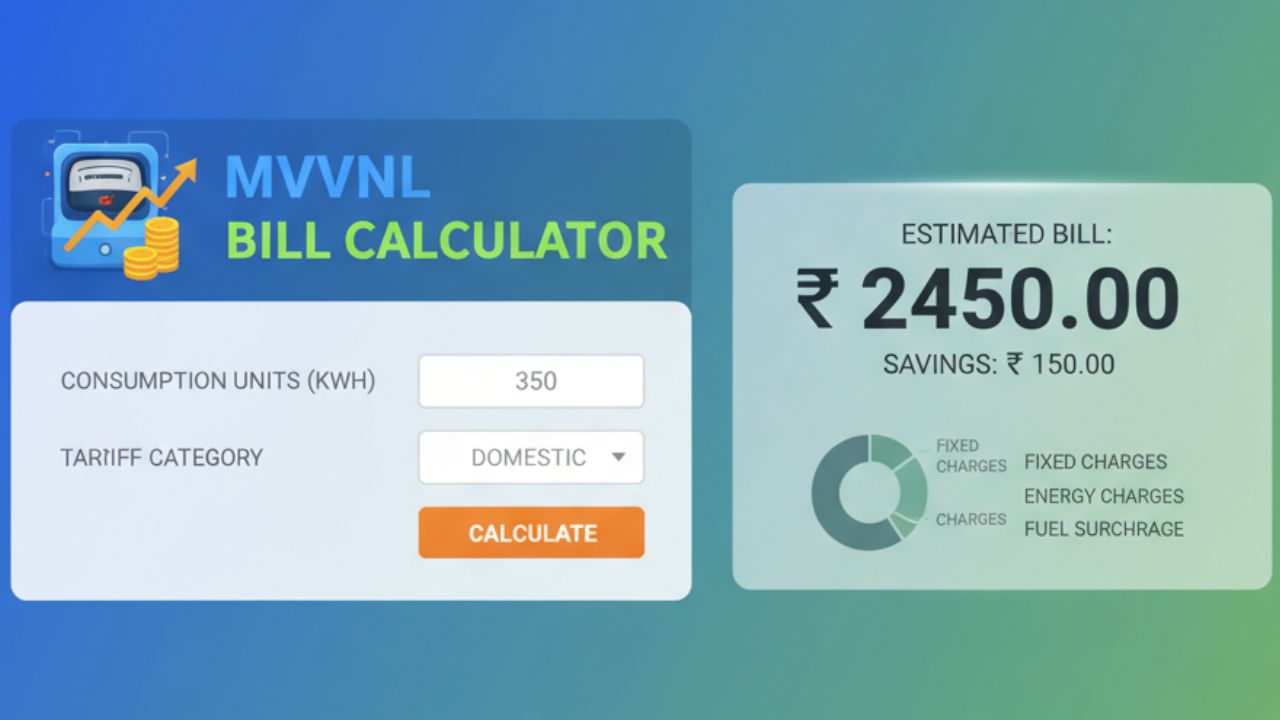
MVVNL Bill Calculator 2026-27
Estimate your Madhyanchal Vidyut Vitran Nigam Limited (MVVNL) electricity bill using FY 2026-27 Uttar Pradesh tariff rates.
MVVNL • FY 2026-27 • Domestic & LMV-2| Slab | Units | Rate | Amount |
|---|
MVVNL Electricity Tariff 2026-27
Madhyanchal Vidyut Vitran Nigam Limited, commonly called MVVNL, distributes electricity across 19 districts in central Uttar Pradesh. Its official supply area includes Budaun, Bareilly, Pilibhit, Shahjahanpur, Lakhimpur Kheri, Hardoi, Sitapur, Unnao, Bahraich, Shrawasti, Balrampur, Gonda, Barabanki, Rae Bareli, Ayodhya, Sultanpur, Ambedkar Nagar, Lucknow and Amethi. This calculator covers the main LMV-1 domestic and LMV-2 non-domestic schedules used by household and small commercial consumers.
MVVNL Urban Domestic Electricity Rates
| Monthly Consumption | Energy Rate |
|---|---|
| 0 to 150 units | ₹5.50 per unit |
| 151 to 300 units | ₹6.00 per unit |
| Above 300 units | ₹6.50 per unit |
| Fixed charge | ₹110 per kW per month |
MVVNL Rural Domestic Electricity Rates
| Monthly Consumption | Energy Rate |
|---|---|
| 0 to 100 units | ₹3.35 per unit |
| 101 to 150 units | ₹3.85 per unit |
| 151 to 300 units | ₹5.00 per unit |
| Above 300 units | ₹5.50 per unit |
| Fixed charge | ₹90 per kW per month |
Life Line and Bulk Domestic Tariff
| Category | Energy Rate | Fixed Charge |
|---|---|---|
| Life Line: 1 kW and up to 100 units/month | ₹3.00/unit | ₹50/kW/month |
| Single point for bulk domestic loads | ₹7.00/unit | ₹110/kW/month |
MVVNL LMV-2 Commercial Tariff 2026-27
| Commercial Category | Energy Rate | Fixed Charge |
|---|---|---|
| Rural Schedule LMV-2 | ₹5.50/unit | ₹110/kW/month |
| Other LMV-2, load up to 4 kW | ₹7.50 up to 300 units; ₹8.40 above 300 | ₹330/kW/month |
| Other LMV-2, load above 4 kW | ₹7.50 up to 1,000 units; ₹8.75 above 1,000 | ₹450/kW/month |
| Minimum charge for other LMV-2 | ₹600/kW/month Apr-Sep; ₹475/kW/month Oct-Mar | |
MVVNL Service Area
MVVNL serves Budaun, Bareilly, Pilibhit, Shahjahanpur, Lakhimpur Kheri, Hardoi, Sitapur, Unnao, Bahraich, Shrawasti, Balrampur, Gonda, Barabanki, Rae Bareli, Ayodhya, Sultanpur, Ambedkar Nagar, Lucknow and Amethi.
How to Use the MVVNL Bill Calculator
Choose your consumer category, enter your sanctioned load, and enter consumption directly or use previous and current meter readings. If you have approved rooftop solar net metering, select the solar option and enter import, export and any previous banked units.
The calculator applies the FY 2026-27 energy slabs, fixed charges, electricity duty and any manual adjustment. For non-rural LMV-2 categories it also checks the published seasonal minimum charge.
Rooftop Solar Net Metering
For an approved bidirectional solar connection, the estimate uses grid import minus solar export and available banked credit, without allowing billable units to fall below zero. Any excess credit is shown separately as estimated carry-forward units.
Frequently Asked Questions
What is the MVVNL urban domestic tariff in 2026-27?
The payable energy rate is ₹5.50 per unit up to 150 units, ₹6.00 from 151 to 300 units, and ₹6.50 above 300 units. The fixed charge is ₹110 per kW per month.
What is the MVVNL rural domestic tariff?
Rural domestic rates are ₹3.35 up to 100 units, ₹3.85 from 101 to 150, ₹5.00 from 151 to 300 and ₹5.50 above 300 units. The fixed charge is ₹90 per kW per month.
Who qualifies for the Life Line tariff?
The FY 2026-27 Life Line tariff is for an eligible 1 kW connection with monthly consumption up to 100 units. The payable energy rate is ₹3.00 per unit and fixed charge is ₹50 per kW per month.
What is the MVVNL commercial rate for load up to 4 kW?
For other LMV-2 consumers with load up to 4 kW, the energy rate is ₹7.50 per unit up to 300 units and ₹8.40 above 300 units. The fixed charge is ₹330 per kW per month.
What is the MVVNL commercial rate above 4 kW?
For other LMV-2 consumers above 4 kW, the energy rate is ₹7.50 per unit up to 1,000 units and ₹8.75 above 1,000 units. The fixed charge is ₹450 per kW per month.
What is the LMV-2 minimum charge?
The FY 2026-27 schedule lists ₹600 per kW per month from April to September and ₹475 per kW per month from October to March for other LMV-2 consumers.
Can I calculate units from meter readings?
Yes. Select Use Meter Readings and enter the previous and current readings. The calculator subtracts the previous reading from the current reading.
Does this calculator support rooftop solar?
Yes. Select approved net metering and enter grid import, solar export and banked solar credit.
Which districts are served by MVVNL?
MVVNL’s official supply area covers 19 districts including Lucknow, Bareilly, Ayodhya, Sitapur, Unnao, Barabanki, Rae Bareli, Gonda, Bahraich and Amethi.
Is this an official MVVNL calculator?
No. It is an independent estimation tool. Your official MVVNL bill is the final billing record.