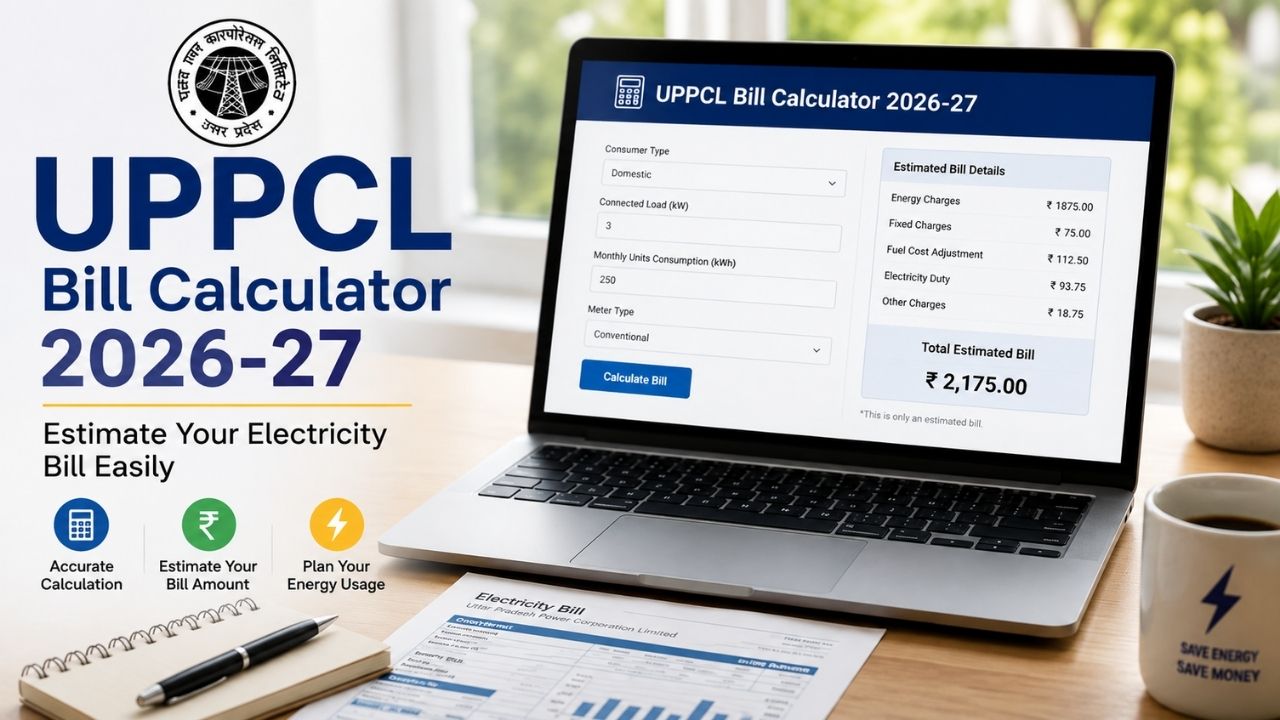
UPPCL Bill Calculator 2026-27

Calculate your Uttar Pradesh electricity bill including the latest free unit limits.

kW
Please enter a valid load (min 1).
Units
Please enter valid consumed units.
Estimated Total Bill
₹0.00
Total Units Consumed: 0
Free Units Applicable: 100% Subsidy – 0
Billable Units (Chargeable): 0
Energy Charge (Based on Slabs): ₹0.00
Fixed Charge (Based on Load): ₹0.00
Electricity Duty (5%): ₹0.00
Total Payable Amount: ₹0.00

FAQs About UPPCL Bill Calculator 2026-27

How many units of electricity are free in UP?
Under the latest government regulations, domestic consumers in Uttar Pradesh receive the first 200 units of electricity completely free of energy charges every month. You only pay for units consumed above this 200-unit threshold.
Do I still get a bill if I use less than 200 units?
Yes. Even if your energy charge is zero because you used less than 200 units, you are still required to pay the “Fixed Charge” based on your sanctioned load (kW) plus the 5% electricity duty levied on that fixed charge.
What is LMV-1?
LMV stands for Light Motor Vehicle, but in the context of UPPCL, LMV-1 is the official tariff category for Light and Fan Domestic lighting. It applies to regular residential homes, as opposed to commercial or industrial connections.
How can I pay my UPPCL bill online?
You can pay your bill directly through the official UPPCL portal (upenergy.in) using your Account ID. Alternatively, you can use popular UPI apps like Google Pay, PhonePe, or Paytm, which fetch your bill automatically when you enter your consumer number.
What is Sanctioned Load?
Sanctioned load is the maximum amount of electricity (in Kilowatts) the power company has authorized for your home based on the appliances you own. If you exceed this load, your meter may trip, and you could face penalty charges.
Why is my bill higher than the calculator estimate?
This calculator provides an estimate based on standard domestic usage. If your actual bill is higher, it may include previous month arrears (late fees), penalty charges for exceeding your sanctioned load, or municipal tax additions specific to your city.
What is the difference between rural and urban tariffs?
Urban (city) connections generally have a higher fixed monthly charge (e.g., ₹110/kW) and slightly higher per-unit slab rates to cover the cost of continuous, high-capacity city grid maintenance. Rural connections have a lower fixed charge (e.g., ₹50/kW).
Does UPPCL charge a late payment fee?
Yes. If you fail to pay your electricity bill by the assigned due date, UPPCL typically levies a late payment surcharge (LPSC) of 1.25% to 1.5% per month on the outstanding principal amount.
Can I change my sanctioned load online?
Yes, UPPCL provides an online facility (Jhatpat Connection portal) where you can apply to increase or decrease your sanctioned load without visiting the local electricity office. You will need to submit a small processing fee.
How is the 5% Electricity Duty calculated?
The 5% Electricity Duty is a government tax. It is calculated by adding your total Energy Charge to your Fixed Charge, and then taking 5% of that sum. It is not calculated on penalty charges or arrears.

UPPCL Bill Calculator: Your Simple Guide to Estimating Electricity Costs in Uttar Pradesh

In today’s busy world, keeping track of bills can be tough. Electricity bills are no exception. If you live in Uttar Pradesh, you might use power from UPPCL. UPPCL stands for Uttar Pradesh Power Corporation Limited. It supplies electricity to millions of homes and businesses.

Now, there’s a handy tool called the UPPCL Bill Calculator. This online tool helps you figure out your monthly bill before it arrives. No more surprises! In this blog, we’ll talk about what this calculator is, its benefits, how to use it, and more. We’ll keep things simple so anyone can understand.

What is UPPCL and Why Do Bills Matter?

UPPCL is the main power company in Uttar Pradesh. It handles electricity for cities and villages. Your bill depends on how much power you use and your type of connection.

Bills include fixed charges and energy charges. Fixed charges are based on your contracted load, like the size of your connection. Energy charges come from the units you consume. There are also subsidies for some users.

Understanding your bill helps you plan your money better. That’s where the UPPCL Bill Calculator comes in. It’s a free web tool that uses the latest rates from 2024-25.

The Need for an Electricity Bill Calculator

Many people get confused by their bills. The rates change based on slabs. Slabs are like levels of usage. Low usage means lower rates. High usage means higher costs.

Calculating by hand is hard. You need to know all the rules. A calculator does the math for you. It’s quick and easy.

This tool is perfect for homes, shops, and farms. It covers rural and urban areas. No need for spreadsheets or complex formulas.

Key Benefits of Using the UPPCL Bill Calculator

One big benefit is saving time. Just enter a few details, and get your estimate in seconds.

It helps you budget. See how much your bill might be. Plan your spending accordingly.

Another plus is accuracy. The tool uses official rates from UPERC. UPERC is the Uttar Pradesh Electricity Regulatory Commission. They set the prices.

UPPCL Bill Calculator

You can try different scenarios. What if you use less power? See how it lowers your bill. This encourages saving energy.

It’s user-friendly. No tech skills needed. The design is simple with clear labels.

For families, it teaches about power use. Kids can learn why turning off lights matters.

Business owners love it too. Estimate costs for shops or small factories. Helps in pricing products.

Rural users get extra help. The calculator shows subsidies for villages. This makes bills cheaper.

It’s mobile-friendly. Use it on your phone or computer. No downloads required.

Finally, it’s free. No hidden fees. Just visit the website and start calculating.

How to Use the UPPCL Bill Calculator Step by Step

Using the calculator is easy. First, open the website in your browser.

You’ll see a header that says “UPPCL Bill Calculator.” Below it, there’s a form.

Step 1: Choose your consumer category. This is your type of connection. Options include domestic rural lifeline, non-domestic urban, and more.

For example, if you’re a home user in a village with low usage, pick “LMV-1 Domestic (Rural – Lifeline).”

Step 2: Enter your contracted load. This is in kW or BHP. Check your bill or meter for this number.

Step 3: Input units consumed. This is the kWh you used in a month. You can estimate or use past bills.

Step 4: Click the “Calculate Bill” button. It’s blue and easy to spot.

In moments, results appear. You’ll see fixed charges, energy charges, subsidy, and total amount.

The results are in rupees with two decimal places. Easy to read.

If something’s wrong, like missing info, it shows an alert. Fix it and try again.

You can reset and try new numbers. Great for testing changes.

Understanding Different Consumer Categories

The calculator has many categories. Let’s explain them simply.

LMV-1 is for homes. Rural lifeline is for poor families using up to 100 units. They get big subsidies.

Rural other is for normal village homes. Rates go up with more units.

Other lifeline is like rural but for cities. Low load and usage.

Other regular is for city homes. Higher rates than rural.

Bulk is for big housing societies.

LMV-2 is non-domestic. Like shops or offices. Rural and other options.

LMV-5 is for tube wells. Used in farms for water pumps. Rural unmetered means no meter, fixed pay per BHP.

Rural metered has a meter and low rates.

Urban tube wells cost more.

LMV-6 is for small businesses with power needs.

Pick the right one for accurate results.

How the Calculator Works Behind the Scenes

The tool uses set rates. For example, rural lifeline has ₹50 fixed per kW. Energy at ₹3 per unit, but subsidy makes it free up to 100 units? Wait, subsidy is ₹3.50, so net pay is low.

It breaks units into slabs. First 100 units cheap, next higher.

For unmetered, no energy charge, just fixed.

Special rules for some, like LMV-2 over 4kW load.

It adds fixed, energy, minus subsidy.

No extra taxes in estimate. That’s why it’s close but not exact.

UPPCL Bill Calculator

Real-Life Examples of Using the Calculator

Imagine a village home. Category: LMV-1 rural other. Load: 2 kW. Units: 150.

Fixed: ₹90 * 2 = ₹180.

Energy: First 100 at ₹3.35 – ₹3.30 subsidy = low net.

Next 50 at ₹3.85 – ₹3 subsidy.

Total around ₹300-400. Use the tool to see exact.

For a city shop: LMV-2 other. Load: 3 kW. Units: 400.

Fixed: ₹330 * 3? Wait, rules vary.

Energy: Up to 300 at ₹7.50, rest ₹8.40.

No subsidy. Bill higher.

Farm tube well: Rural metered. BHP: 5. Units: 200.

Fixed: ₹70 * 5 = ₹350.

Energy: ₹2 per unit, subsidy ₹4.50. Net negative? Wait, effective low cost.

These examples show variety.

Tips to Reduce Your UPPCL Electricity Bill

Want lower bills? Use less power.

Switch to LED lights. They use less energy.

Turn off fans when not in room.

Use efficient ACs and fridges.

For farms, get energy-saving pumps. Qualify for better rates.

Track usage monthly. Use calculator to predict.

Go solar if possible. Reduces grid dependence.

Avoid peak hours if your area has time-based rates.

Insulate home to need less cooling.

Small changes add up.

Common Mistakes to Avoid When Using the Calculator

Don’t pick wrong category. Check your bill.

Enter exact load. Not guess.

Units should be monthly average.

Remember, it’s estimate. Actual may have extras like duty.

Update if rates change yearly.

Don’t forget subsidies if eligible.

If error, check inputs.

Why This Calculator Stands Out

Many tools exist, but this is tailored for UPPCL.

Beautiful design. Gradient colors, easy on eyes.

Has FAQ section. Answers common questions.

Description explains everything.

Mobile responsive. Works on small screens.

No ads or popups.

Updated for 2024-25 rates.

The Future of Bill Calculators

Tech is changing. Soon, apps might link to meters directly.

AI could predict bills based on habits.

But for now, this web tool is great.

UPPCL might launch official one, but this fills the gap.

Conclusion: Take Control of Your Electricity Costs

The UPPCL Bill Calculator is a must-try. It empowers you with knowledge. Estimate, plan, save.

Whether home or business, it helps.

Try it today. Enter your details and see.

Share with friends in Uttar Pradesh.

Stay informed, stay saving.


Disclaimer: This blog and the UPPCL Bill Calculator provide estimates based on public tariff data. Actual bills may differ due to additional charges, taxes, or changes in rates. Always check your official UPPCL bill for exact amounts. This is not official advice from UPPCL. Use at your own risk.