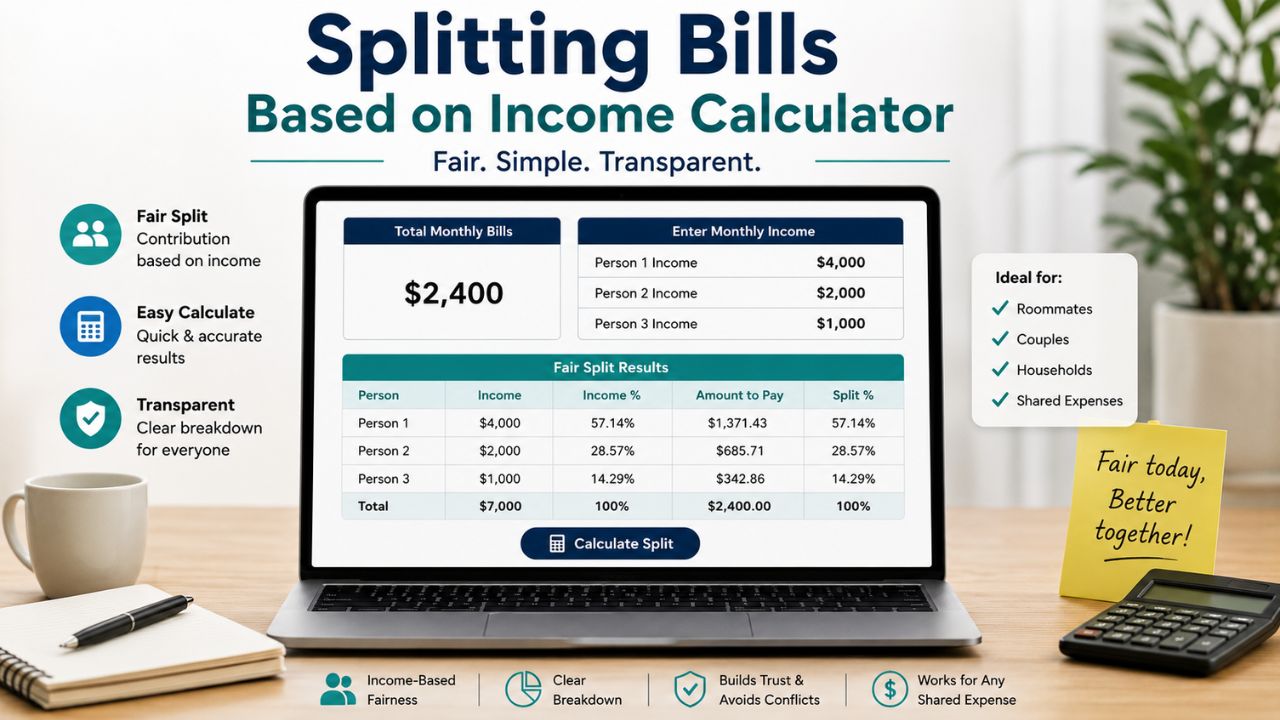
Splitting Bills Based on Income Calculator
Split shared household bills based on each person’s share of total income.
Income-Based Split • Up to 4 People • Equal Split ComparisonPerson 1
Person 2
Person 3 (Optional)
Person 4 (Optional)
| Person | Income | Income Share | Income-Based Bill Share | Difference vs Equal Split |
|---|---|---|---|---|
| Person 1 | $0.00 | 0% | $0.00 | $0.00 |
| Person 2 | $0.00 | 0% | $0.00 | $0.00 |
| Person 3 | $0.00 | 0% | $0.00 | $0.00 |
| Person 4 | $0.00 | 0% | $0.00 | $0.00 |
How to Split Bills Based on Income
An income-based bill split divides shared expenses according to each person’s percentage of the household’s combined income. Someone who earns a larger percentage of the combined income contributes the same percentage toward shared bills.
This approach can be useful for couples, roommates, families, and other households where incomes differ significantly.
Income-Based Bill Split Formula
Add everyone’s income to calculate combined household income. Then divide each person’s income by the combined income. This gives that person’s income percentage.
Multiply the shared bills by that percentage to calculate the person’s contribution.
For example, if Person 1 earns $4,000 and Person 2 earns $6,000, combined income is $10,000. Their income percentages are 40% and 60%. If shared expenses are $3,000, their contributions are $1,200 and $1,800.
Should You Use Gross or Net Income?
You can use either gross income or net income. Net or take-home income may be more useful for household budgeting because it represents money available after payroll deductions and taxes.
Whichever method you choose, everyone should use the same basis.
What Bills Can Be Split by Income?
Shared expenses may include rent, mortgage payments, electricity, water, internet, groceries, insurance, childcare, household subscriptions, and other expenses used by everyone in the household.
Personal debts and individual discretionary spending can be kept separate unless everyone agrees to include them.
Income-Based Split vs Equal Split
An equal split divides the total bill by the number of people. An income-based split instead assigns each person a percentage based on their share of combined income.
The calculator displays both methods so you can see how much more or less each person would contribute compared with an equal split.
Frequently Asked Questions
How do you split bills based on income?
Divide each person’s income by total household income. Multiply that percentage by the total shared bills.
What is the proportional bill splitting formula?
Bill share = person’s income ÷ combined household income × total shared expenses.
Should couples split bills 50/50?
Some couples use an equal split while others use an income-based percentage. The arrangement depends on their finances and agreement.
Should I use gross or net income?
Either can be used. Net income may better represent money actually available for expenses. Everyone should use the same income basis.
Can three people split bills based on income?
Yes. This calculator supports up to four people.
Can I leave Person 3 or Person 4 unused?
Yes. Leave their income at zero and they will not be included in the calculation.
Can roommates use this calculator?
Yes. It can be used when roommates agree to divide shared expenses according to income.
Do all income amounts need the same time period?
Yes. If you enter monthly income, all incomes and the shared bill total should use monthly amounts.
Does the calculator support multiple currencies?
Yes. It supports USD, CAD, AUD, EUR, GBP, INR, AED, and SGD. The currency selector changes formatting only and does not perform exchange-rate conversion.
Is an income-based split always fair?
It is one budgeting method. Households may also consider debt, savings goals, childcare, ownership, personal expenses, and other circumstances when deciding how to divide costs.