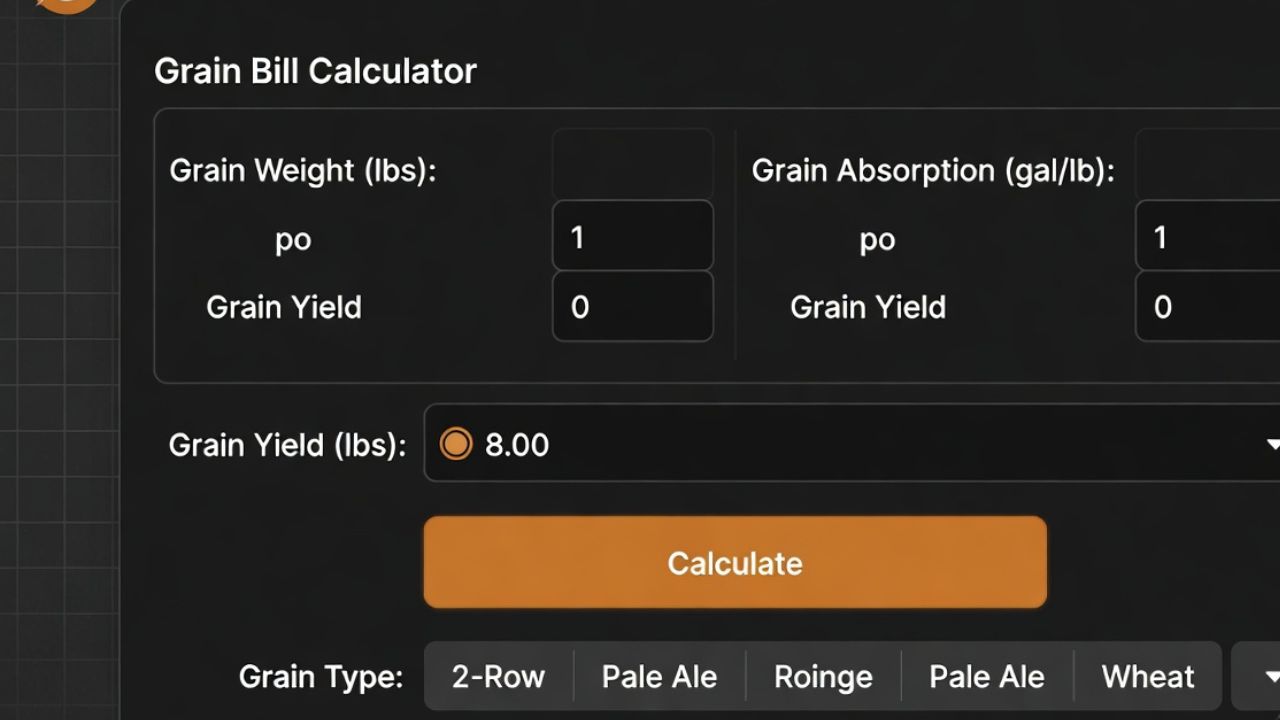
Brewing Grain Bill Calculator
Calculate the total grain weight needed to reach your target Original Gravity (OG) for any batch size.
Grain Bill & Brewing FAQs
The grain bill (or grist) is the list of all the different malts and adjuncts used to make a batch of beer. It determines the color, body, fermentable sugars, and overall flavor profile of the brew.
PPG stands for Points per Pound per Gallon. It represents the maximum amount of sugar a grain can contribute to one gallon of water. For example, a grain with 37 PPG would give 1 gallon of water a gravity of 1.037.
Efficiency measures how well your system extracts sugars from the grain. Most homebrewers land between 65% and 75%. If your efficiency is low, you will need to add more grain to hit your target gravity.
The formula is: $$\text{Weight (lbs)} = \frac{\text{Total Gravity Points}}{\text{PPG} \times \text{Efficiency}}$$ Total Gravity Points is calculated as $(\text{Target OG} – 1.000) \times 1000 \times \text{Batch Size}$.
A finer crush increases the surface area of the grain, making it easier for enzymes to convert starches into sugars, which raises efficiency. However, a crush that is too fine can cause a “stuck sparge.”
Base malts (like 2-Row or Pilsner) make up 80-100% of the bill and provide the enzymes needed for conversion. Specialty malts (like Caramel or Chocolate malt) provide color and flavor but often have little to no enzymatic power.
To increase ABV, you must increase the Original Gravity. In this calculator, simply raise the “Target Original Gravity” value, and it will tell you the additional grain weight required to reach that potential.
No. This calculator focuses on the **total** fermentables needed for the final volume. The mash thickness (quarts of water per pound of grain) affects enzyme activity but not the raw math of sugar potential.
This refers to the enzymatic strength of the grain bill. You need enough base malt (which has high diastatic power) to convert the starches in your specialty grains and adjuncts into fermentable sugars.
A common rule of thumb is assuming a standard yeast attenuation of 75%. The formula used here is: $(OG – FG) \times 131.25$. If your OG is 1.050 and it ferments to 1.012, your ABV is roughly 5.0%.
Grain Bill Calculator: Nail Your Homebrew Recipes Every Time
Hey there, fellow beer lover. If you’ve ever stood in your kitchen staring at a pile of grain bags wondering how much of each malt to toss in your mash tun, you’re not alone.
A grain bill calculator takes all that guesswork out of the equation. It tells you exactly how much of each malt you need to hit your target original gravity, color, and flavor profile.
Why You Need a Grain Bill Calculator Right Now
Let’s be honest. Brewing great beer is part art and part math. The grain bill (that list of malts and their weights) is the heart of every all-grain recipe. Without a smart way to balance it, you risk missing your numbers and ending up with flat or overly sweet beer.
That’s exactly where a grain bill calculator shines. It does the heavy lifting so you can focus on the fun stuff—like tasting your creation. Whether you’re brewing a crisp pilsner or a robust stout, this simple tool keeps everything on track.
What Exactly Is a Grain Bill Calculator?
Think of it as your personal brewing assistant. You plug in three basics: your batch size (say, 5 gallons), your target original gravity (maybe 1.055 for a solid IPA), and your brewhouse efficiency (most homebrewers land around 70-75%).
The calculator then crunches the numbers using real brewing formulas. It spits out the exact weight of each malt you need. Some versions even estimate the final color in SRM (Standard Reference Method) so you know if your beer will look golden or deep amber before you even boil.
No more spreadsheets or head-scratching. Everything updates live as you tweak the percentages. It’s like having a brewing mentor in your pocket.
The Real Benefits Homebrewers Love
Here’s why thousands of us swear by these tools:
- Perfect gravity every time — No more surprise low-ABV beers.
- Accurate color prediction — Know exactly how dark your porter will be.
- Saves money — You buy only what you need instead of guessing and wasting grain.
- Speeds up recipe design — Go from idea to brew day in minutes.
- Great for scaling — Want to make 10 gallons instead of 5? Just change one number and everything adjusts.
How a Grain Bill Calculator Works (Without the Nerdy Math)
Don’t worry. You don’t need a science degree. Here’s the simple flow most calculators follow:
- Enter your batch volume.
- Set your target OG (original gravity).
- Input your system’s efficiency.
- Add grains one by one (2-row, crystal 60, chocolate malt, etc.).
- Adjust the percentages so they add up to 100%.
- Hit calculate.
The tool multiplies each grain’s potential points (PPG) by its weight, factors in your efficiency, and shows the final gravity. It also runs a quick color calculation so you see the SRM number and sometimes even a little color swatch.
Want a quick comparison? Here’s a tiny table I keep handy:
| Method | Time to Calculate | Accuracy | Fun Factor |
|---|---|---|---|
| Pen & paper | 45 minutes | Okay | Low |
| Grain bill calculator | 3 minutes | Spot-on | High |
| Brewery software | 10 minutes | Excellent | Medium |
See? The calculator wins for most of us weekend warriors.
Step-by-Step: Using Your First Grain Bill Calculator
Ready to try one? Here’s exactly what I tell my brewing buddies:
- Pick a simple tool — Search for a free online version or paste a lightweight HTML calculator into your WordPress site.
- Start with a classic recipe — Let’s say you want an American pale ale.
- Enter your numbers — 5 gallons, OG 1.052, 72% efficiency.
- Add your grains — 80% 2-row pale, 15% crystal 40L, 5% carapils.
- Tweak and watch — The weights update instantly. Total grain might read 9.8 lbs.
- Check the color — It might show 8 SRM (nice amber).
- Save or print — Boom—your recipe is locked and loaded for brew day.
Pro tip: Always double-check your total percentage adds to 100%. Most good calculators flash a warning if it doesn’t.
Common Mistakes New Users Make (and How to Avoid Them)
Even with a calculator, a few slip-ups happen:
- Forgetting to update efficiency after changing your mash tun.
- Using the same percentages for every style (stouts need more roasted malt!).
- Ignoring water chemistry—grain affects pH, so keep notes.
Tips to Take Your Grain Bills to the Next Level
Want to brew like the pros? Try these:
- Build a personal malt library — Save your favorite combinations for quick loading.
- Experiment safely — Change only one grain at a time and keep records.
- Think about adjuncts — Add oats or rye and watch how the calculator adjusts gravity.
- Pair with a water calculator — Grain and water work together for better flavor.
- Share with your club — Post your calculated recipes on homebrew forums for feedback.
These little habits turned my beers from “pretty good” to “where did you buy this?”
FAQs About Grain Bill Calculators
What is a grain bill in homebrewing?
It’s simply the list of malted grains and their exact weights that make up your recipe. The grain bill decides your beer’s body, color, and fermentable sugars.
How accurate are grain bill calculators?
Most hit within 2-3 points of your target gravity when you measure your actual efficiency. They’re way more reliable than manual math, especially for beginners.
Can I use one for extract brewing too?
Absolutely. Just switch the mode or lower your efficiency number. Many calculators handle both all-grain and partial-mash recipes with a single click.
Conclusion
A grain bill calculator isn’t just a gadget. It’s the shortcut that turns good homebrewers into great ones. You spend less time crunching numbers and more time enjoying the process (and the finished beer).
Grab a free calculator today, plug in your next recipe idea, and watch your confidence skyrocket. Your future self—and your tasting buddies—will thank you.
Disclaimer: This article shares general brewing knowledge for educational purposes only. Always follow safe brewing practices, check local regulations, and consult equipment manuals. Results can vary based on your unique setup.